The Digital Jobsite: The Wireless Backbone of Modern Construction
This document discusses the crucial role of wireless technology in enhancing efficiency and connectivity in the construction industry, as presented by Thomas Berrington, Chief Information Officer at French Brothers Homes.
Contact Centers
Bigleaf
EPISODE: Thomas Berrington Chief Information Officer @ French Brothers Homes The Digital Jobsite: The Wireless Backbone of Modern Construction Episode 36
What’s Inside [1:08] Introduction to Thomas Berrington [27:44] Full Podcast Episode [2:15] Highlights Video [3:21] Why Data Ownership Is The Foundation For Forecast Accuracy [2:57] Managing Construction As A Project Management Business [3:26] The Productivity Impact Of Cloud-Based Construction [3:16] How Data Guides Smarter Homebuilding Decisions [2:10] Improving Homebuyer Confidence With Data And 3D Tools [1:21] Why Mobility Is Non-Negotiable In Modern Construction [2:35] How Downtime Creates Chaos Across Construction Schedules [2:26] Designing Reliable Connectivity For Dynamic Jobsites [1:10] Securing Cloud Applications On Wireless Networks [1:16] How Data And Connectivity Enable Scalable Operations [0:50] Short - Why Data Ownership Is The Foundation For Forecast Accuracy [0:53] Short - Designing Reliable Connectivity For Dynamic Jobsites
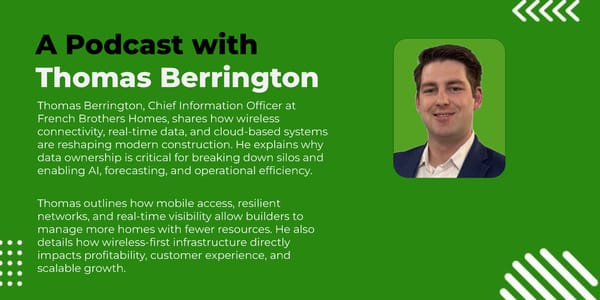
EPISODE: A Podcast with Thomas Berrington Thomas Berrington, Chief Information Officer at French Brothers Homes, shares how wireless connectivity, real-time data, and cloud-based systems are reshaping modern construction. He explains why data ownership is critical for breaking down silos and enabling AI, forecasting, and operational efficiency. Thomas outlines how mobile access, resilient networks, and real-time visibility allow builders to manage more homes with fewer resources. He also details how wireless-first infrastructure directly impacts profitability, customer experience, and scalable growth.
Full Episode “Having the data at our fingertips and having that ownership allows us to make data-driven decisions. We have gone from managing five to ten homes per builder to fifteen to twenty homes at a time because of connectivity and cloud-connected data, and maintaining that connectivity is essential to operating and growing in today’s business environment.”
5 (2:15) Highlights Video

(3:21) Why Data Ownership Is The Foundation For Forecast Accuracy “I really had that mentality around the importance of data ownership. It allows us to break down the silos of legacy systems or fragmented systems.”
(2:57) Managing Construction As A Project Management Business “Our job is to use all of those data points and bring them together to manage the project and manage the completion of that home. That means having data on task completion and quality assessments, and then communicating them to the customer so they know where progress is”
8 (3:26) The Productivity Impact Of Cloud-Based Construction “Our builders are handling fifteen to twenty homes at a time because it is easier to see everything from the field. With that connectivity and cloud-connected data, they can see where each home is, which trades are in the home, which tasks are being completed, and which ones they need to follow up on.”
(3:16) How Data Guides Smarter Homebuilding Decisions “Data-driven leadership is really about removing emotion from a lot of the decisions within business. It becomes more important to build based on data rather than emotion because the data helps us define what to build, the price point we need to hit, and how to build homes that the majority of people can afford.”
(2:10) Improving Homebuyer Confidence With Data And 3D Tools “It is really hard to make what is typically the biggest investment in most people’s lives based on small paint chips and sample door colors. Having everything visualized in a digital environment creates a seamless customer experience and builds an emotional attachment while allowing us to capture valuable data.”
11 (1:21) Why Mobility Is Non-Negotiable In Modern Construction “The construction industry is critical for mobile technology. It is one of the few industries where we are constantly on the move. If you are in the same place too long, you are dying as a construction business because you are not building anything. It has already been built.”
(2:35) How Downtime Creates Chaos Across Construction Schedules “When the network goes down in the field, it eliminates our ability to communicate the completion of tasks and understand where the project stands. It removes that inbound feedback from our builders and construction managers about what is happening in the field.”
(2:26) Designing Reliable Connectivity For Dynamic Jobsites “The key points I look at are the resiliency of the network, the connectivity, the failover of the network itself, and latency. We want very low latency and very high resiliency. We rely on cellular networks in the field and use a mixed-basket approach where not everyone is on the same carrier. If one carrier goes down, we may still have someone in the field not experiencing issues.”
14 (1:10) Securing Cloud Applications On Wireless Networks “We have not experienced any issues running cloud-based applications on a wireless-first network. We rely on built-in security protections, role-based access controls, and a zero-trust architecture. That allows us to feel secure enough and risk-aware enough to support our business operations.”
(1:16) How Data And Connectivity Enable Scalable Operations “Data is critically important to modern-day operations. Organizations that understand this and have roles dedicated to making data as efficient and as connected as possible are much better positioned to scale.”
YOUTUBE SHORT: “I really had that mentality around the importance of data ownership. It allows us to break down the silos of legacy systems or fragmented systems.” - Thomas Berrington
YOUTUBE SHORT: “The key points I look at are the resiliency of the network, the connectivity, the failover of the network itself, and latency. We want very low latency and very high resiliency. We rely on cellular networks in the field and use a mixed-basket approach where not everyone is on the same carrier. If one carrier goes down, we may still have someone in the field not experiencing issues.” - Thomas Berrington
Watch our podcast on your favorite platform